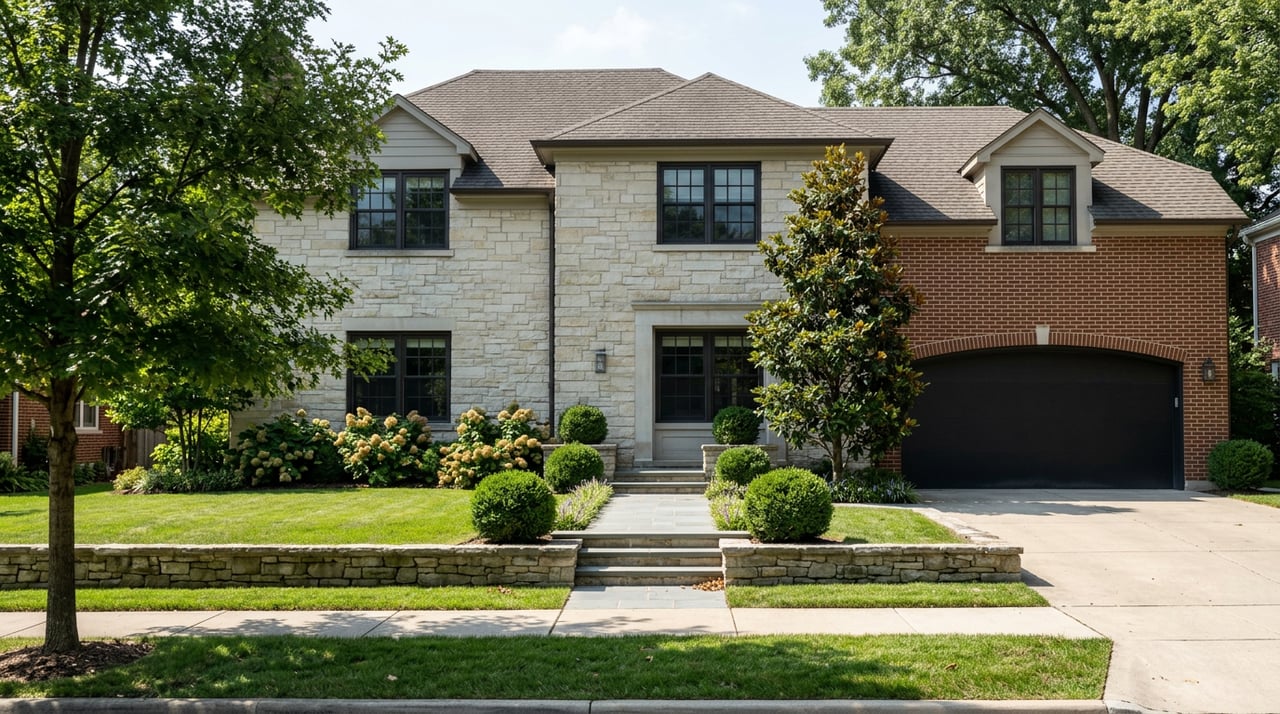
Two houses sit on streets called Connecticut Avenue less than five miles apart. One is inside Washington, DC, in the Chevy Chase neighborhood. The other is a few blocks north in Chevy Chase Village, Maryland, a separate municipality inside Montgomery County. Same name. Same architectural vintage in some cases. As of November 1, 2025, they answer to completely different rulebooks, and the Maryland side just got a lot more interesting for anyone who owns, or is evaluating, a house that happens to front the right stretch of pavement.
The DC house hasn't changed at all. The Maryland house, if it sits on one of seven qualifying parcels along Connecticut Avenue in Chevy Chase Village, now has legal access to a building type it couldn't touch a year ago.
What Actually Took Effect on November 1
Montgomery County's Zoning Text Amendment 25-02, part of a package the council called More Housing N.O.W., passed 8-3 in July 2025 and became effective November 1, 2025. It allows duplexes, triplexes, townhouses, and small apartment buildings, capped at 40 feet, in the R-40, R-60, R-90, and R-200 zones that for decades permitted only a single detached house per lot.
Councilmembers Andrew Friedson and Natali Fani-González introduced the bill in January 2025, after the county's broader Attainable Housing Strategies process stalled under political pressure, including a public fight in Bethesda's Kenwood neighborhood that made the county's zoning debate a regional story. Friedson framed the goal plainly, saying the change was meant
"so that our teachers, firefighters, police officers, and nurses can afford to live in our community."
That's the headline most coverage ran with: Montgomery County legalizes missing middle housing. It's accurate. It's also the wrong takeaway for almost everyone who owns a single-family home in the county.
The Number That Changes How You Should Read This Law
Montgomery Planning's own eligibility analysis puts the actual footprint of ZTA 25-02 at about 2,429 parcels countywide, roughly 2,051 of which are currently single-family detached homes. The county has approximately 184,500 single-family detached parcels total. Do the math and the law touches about 1.1 percent of them.
That's not a rounding error. It's the whole story. ZTA 25-02 isn't a blanket upzoning. It's a narrow, corridor-specific carve-out that only applies where a lot's front line physically abuts a road the county has classified as a Boulevard, Downtown Boulevard, Downtown Street, Town Center Boulevard, or Controlled Major Highway, and where that corridor is master-planned at least 100 feet wide with three or more existing travel lanes.
Here's what qualifies, at a glance:
| Requirement | Standard |
|---|---|
| Zones affected | R-40, R-60, R-90, R-200 |
| Frontage | Must abut a Boulevard, Downtown Boulevard, Downtown Street, Town Center Boulevard, or Controlled Major Highway |
| Corridor width | At least 100 feet, master-planned |
| Travel lanes | Three or more existing |
| Max height | 40 feet |
| Max density | 1.25 Floor Area Ratio |
| Workforce housing set-aside | 15% of units, or a minimum of 1 unit for any project of 3 or more units |
| Workforce housing income cap | Up to 120% of area median income, currently $157,440 for a couple |
If your street doesn't meet that frontage test, none of this applies to you, regardless of your zone. That's the detail that separates a homeowner reading a news headline from someone who actually knows how to check their own address.
Nine Parcels in One of the County's Priciest Zip Codes
Chevy Chase Village, the small incorporated municipality inside Montgomery County (distinct from both the Maryland unincorporated Chevy Chase area and the DC neighborhood across the District line), published its own count after the council vote: exactly seven eligible properties along Connecticut Avenue and two along Wisconsin Avenue. Nine parcels, in a village otherwise built almost entirely of single-family detached houses on some of the county's most valuable land.
Zip code 20815, which covers much of Chevy Chase, posted a median sale price around $1,376,000 over the trailing twelve months as of August 2026, among the highest in the county. Against that backdrop, nine parcels with by-right access to triplex or small apartment development sit inside a market where the countywide median sale price ran from roughly $615,000 in August 2026 to about $660,000 in April 2026, depending on the source and the month measured. The gap between what a typical Chevy Chase Village house sells for and what a corridor-eligible lot could be worth if redeveloped under ZTA 25-02 is not a rounding error either.
Why the Corridor Line Is a Value Line
This is where the researcher persona actually lives: not in the zoning text, but in what it does to a specific lot's ceiling. A house on the wrong side of a corridor boundary, even one block off Connecticut Avenue, is still capped at whatever a single detached house can fetch. A house on the right side, with frontage on the qualifying stretch, now carries a legal path to a duplex, triplex, or small apartment building at up to 1.25 FAR and 40 feet, a materially different unit economics story if the land is redeveloped rather than resold as-is.
Comparable sales tools built for typical single-family transactions don't distinguish between those two lots. Neither does a standard automated valuation model. The corridor eligibility map published by the county exists, but most sellers, and more than a few agents, have never looked at it. That gap between what the market is pricing and what the zoning actually allows is exactly the kind of information asymmetry that rewards someone who does the entitlement homework before listing, not after.
The Fine Print That Keeps This From Being a Free Lunch
None of this is a rubber stamp. When the council adopted the companion Subdivision Regulation Amendment, SRA 25-02, on October 14, 2025, it tightened the path considerably. Property owners can't simply buy up a block of eligible lots and build at will. The SRA caps assemblage at no more than three lots, with a maximum consolidated size set at three times the median lot size of eligible parcels in that zone. Flag lots are excluded entirely, and the county created a new "Shared Access Lot" definition specifically to prevent land assembled behind an existing house from qualifying.
Every application still goes through the county's standard development review, including a Development Review Committee meeting and a Planning Board public hearing, which means abutting neighbors get notice and the chance to testify before anything gets approved. And any project of three or more units has to set aside at least 15 percent of them, or a minimum of one unit, as workforce housing affordable to households earning up to 120 percent of area median income for a minimum of 20 years.
That combination, a narrow eligibility map, a hard assemblage cap, and a workforce housing requirement attached to anything beyond a duplex, is precisely the kind of friction that separates a theoretical zoning win from a project that actually pencils. It's also the exact terrain where feasibility work before a sale, not after, determines whether a corridor-facing lot sells for what a single-family comp suggests or for what its entitlement potential actually supports.
What This Means If You're Comparing Neighborhoods Right Now
If you're weighing Chevy Chase against Bethesda against another Montgomery County corridor town, the honest answer is that the county-wide median tells you almost nothing useful. In March 2026, the median listing price across the entire county sat at $599,995, according to housing inventory data tracked by the Federal Reserve Bank of St. Louis. That single figure blends starter townhouses near Wheaton with multimillion-dollar colonials in Potomac. It cannot tell you what a specific corridor-facing lot is worth, and it certainly cannot tell you which side of a frontage line a given address falls on.
The same logic applies to ZTA 25-02. Two houses a block apart, similar size, similar era, similar assessed value, can now carry entirely different redevelopment ceilings depending on which side of an invisible frontage line they sit on. That line is public information. Very few buyers, sellers, or even agents have checked it against a specific address before making a decision.
A Few Direct Questions
Does ZTA 25-02 apply to Chevy Chase, DC? No. The DC neighborhood is governed by the District's own zoning code, not Montgomery County's. Only properties in Maryland's Montgomery County, including Chevy Chase Village and the unincorporated Chevy Chase area, fall under this law.
How do I find out if a specific address is eligible? Eligibility depends on whether the lot's front line abuts a qualifying corridor classification and meets the width and lane requirements. The county has published an eligible parcel map, and confirming a specific address against it is a matter of checking the parcel record and corridor classification together, not guessing from the street name.
Does the workforce housing requirement apply to a simple duplex? The 15 percent set-aside, or one-unit minimum, applies to projects of three or more units. A straightforward duplex conversion under ZTA 25-02 does not trigger the workforce housing requirement on its own.
If you're trying to figure out whether a property you own, or one you're evaluating, sits inside this narrow corridor window, that's exactly the kind of pre-listing or pre-purchase question worth answering before a price gets set. Broad Branch Group unlocks your property's highest and best use, and a five-minute parcel check against the corridor map is often the difference between pricing a house and pricing what it could legally become.